Title: Emergent Review: When Vibe Coding Puts on its Big Boy Pants
TL;DR:
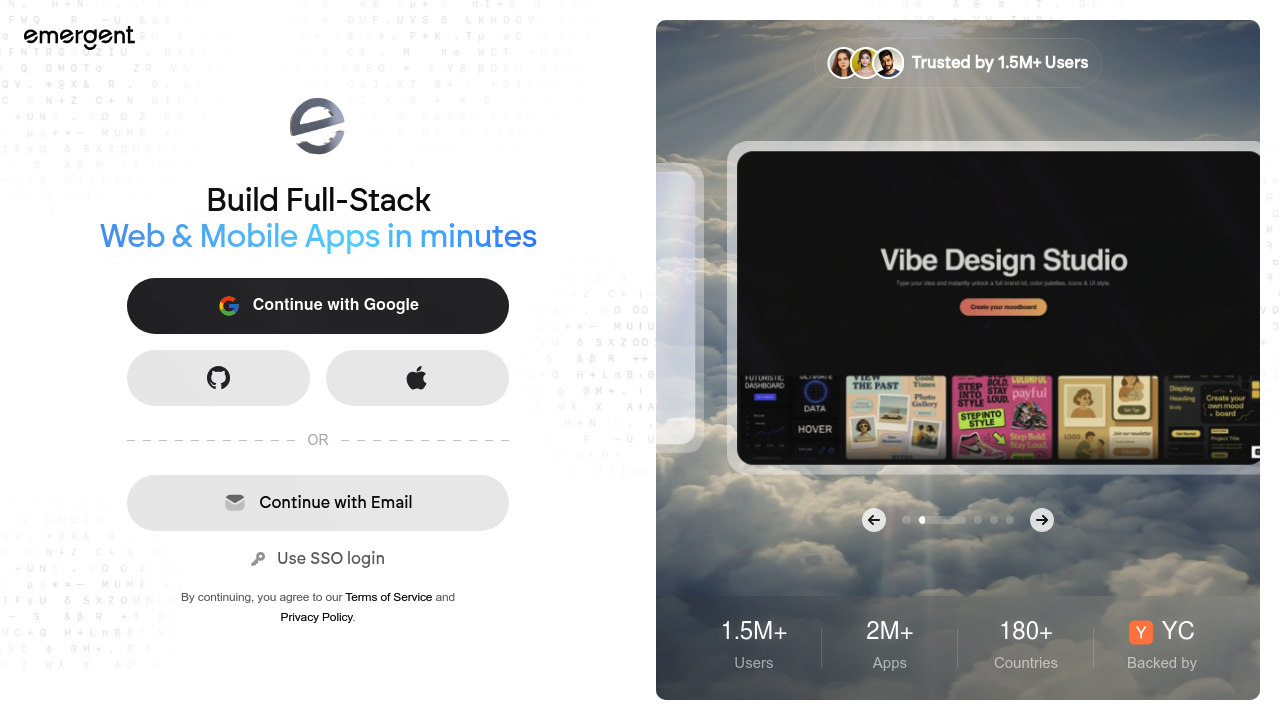
Emergent (app.emergent.sh) is the heavy lifter of the vibe coding world. While tools like Lovable and Bolt are great for spinning up pretty frontends, Emergent uses a multi-agent system to build robust, full-stack applications with real backends, databases, and authentication. It’s powerful, “agentic,” and impressive, but watch out for the credit-based pricing model—it can burn through your wallet if you get stuck in a debugging loop.
We are living in the golden age of "vibe coding." You have an idea, you type it into a text box, and boom—you have a website.
But if you’ve spent more than five minutes in this space, you know the heartbreak. You ask for a simple "To-Do List," and it looks great. Then you ask for "User Accounts" or "Stripe Payments," and the whole thing falls apart. The AI hallucinates a backend, mocks the database, and leaves you with a hollow shell that looks like an app but acts like a PowerPoint presentation.
Enter Emergent.
Emergent isn't just trying to write code for you; it's trying to be your engineering team. It claims to be the first "Agentic" platform. Instead of one AI trying to do everything, it spins up a squad: a Product Manager to plan, an Architect to design the structure, a Coder to write the script, and a QA Tester to break it before you do.
If you are tired of building toys and want to build tools, this is the review for you.
What is Emergent? (And Why Should You Care?)
Emergent is a web-based AI software builder. Like its competitors, it offers a chat interface where you describe what you want.
However, the "secret sauce" is in the Multi-Agent Architecture.
When you prompt Emergent, it doesn't just start vomiting React components. It pauses. It thinks. It creates a plan.
- The Planner breaks your request into steps.
- The Builder writes the code (Frontend and Backend).
- The Tester actually runs the app in a virtual machine (VM) to see if it works.
- The Fixer reads the error logs and iterates.
This loop—Plan, Build, Test, Fix—is what human developers do. Emergent automates the tedious part of that loop. It creates fully functional apps with real Postgres databases, Supabase authentication, and server-side logic from day one.
The "Good Stuff" (Features & Specs)
Here is why the cool kids in r/vibecoding are talking about it:
- Real Full-Stack Capability: Most tools fake the backend. Emergent spins up a real backend (often Python/Flask or Node) and a real database. You can build a functioning SaaS, not just a landing page.
- The "Universal Key": This is a nerdy but huge feature. Usually, if your AI app needs to call OpenAI’s API, you have to go buy your own API key and paste it in. Emergent lets your deployed app use your Emergent credits. It smooths out the "integration hell."
- Dedicated VMs: You aren't just running in a browser sandbox. Each project gets its own Virtual Machine. This means you can install weird Python libraries, run cron jobs, and do "real dev stuff."
- Code Ownership: You can sync directly to GitHub. If you decide to cancel your subscription, you don't lose your IP. You take your ball and go home.
Real-World Use Case: The "Internal Tool"
Let’s say you run a small logistics company. You need a dashboard where drivers can upload photos of delivery receipts, and an admin can approve them.
- With standard AI tools: You get a page that looks like a dashboard. The "Upload" button does nothing.
- With Emergent: You type: "Build a mobile-friendly dashboard. Drivers log in with email. They upload a photo. The photo is stored in the database. Admins see a grid of photos and can click 'Approve'."
Emergent will set up the image storage bucket, the user roles (Admin vs Driver), and the database schema. It might take 10 minutes and cost you $5 in credits, but you end up with a working tool, not a mockup.
Comparisons: Emergent vs. The World
The vibe coding directory is getting crowded. Here is where Emergent sits:
Emergent vs. Lovable
Lovable is the designer's darling. It makes beautiful UIs (User Interfaces). If you are building a landing page or a simple visual tool, use Lovable. Emergent’s UI can sometimes look a bit "bootstrappy" out of the box, but its brain is bigger. Use Emergent for logic; use Lovable for looks.
Emergent vs. Bolt.new
Bolt is fast. It’s incredible for React apps. But Bolt sometimes struggles when you need a heavy backend or complex database relationships. Emergent is slower—because it’s doing more "thinking"—but it’s less likely to hallucinate a database connection that doesn't exist.
Emergent vs. Replit
Replit is an IDE (Code Editor) with AI sprinkled on top. It expects you to know a little bit about what you're doing. Emergent is more "No-Code" friendly. You can drive Emergent without knowing what a requirements.txt file is.
What the Community Says
The internet is a harsh critic, and the feedback on Emergent is refreshingly honest.
One user on Product Hunt noted the reliability:
"With Emergent, I had a fully functional app on my first attempt... I focused on improving the UI gradually. This incremental development strategy works like a charm."
However, the pricing model gets some heat on Reddit:
"The platform eats up credits for every single thing the AI does... User after user reports that these credits vanish way faster than they expected." — r/vibecoding
Another Redditor, Steve Grady, highlighted the backend power:
"I built a rather complex business assessment tool that required a database... I especially appreciated the automated testing before publishing functions. Publish was clean, and my app is live."
Pricing: The "Credit" Warning
Emergent uses a credit system, and you need to pay attention here.
- Standard Plan ($17/month): Gets you in the door with ~100 credits.
- Pro Plan ($167/month): The big jump. 750 credits, bigger context window (so it remembers more of your code), and priority support.
The Catch: Everything costs credits. Coding costs credits. Fixing its own bugs costs credits. If the AI gets confused and spins in a circle trying to fix a typo, it can drain your wallet. It’s like a taxi meter that keeps running even when the driver is lost.
Pro Tip: Start with the $17 plan to test the waters. Be specific with your prompts to stop the AI from wasting "thinking time."
FAQ
Can I export the code?
Yes. You can sync to GitHub and run the code on your own server if you want.
Is it really "No-Code"?
Basically, yes. You interact with English. But knowing a little bit about how software works helps you guide the "Manager" agent when it gets stuck.
Why is it so expensive compared to ChatGPT?
Because it's running multiple agents and a virtual machine. It’s doing the work of a junior dev, not just a text generator.
Summary
Emergent is for the builder who is done playing games. It is for the founder who wants an MVP that actually works, or the employee who wants to automate a workflow without waiting six months for the IT department.
It isn't the cheapest option, and the UI isn't always the prettiest right out of the gate. But under the hood, it is one of the most capable "AI Software Engineers" available today. If you want to move beyond "Hello World" and start shipping real products, Emergent is the tool to beat.
Ready to see if it can build your idea?
Start Building With Emergent Now